
President’s Note
Still Waiting on a State Budget — and Still Waiting on Action for Public Schools
North Carolina is still waiting for a comprehensive state budget, and once again our public schools are feeling the impact.
Last week Governor Josh Stein, Senate President Pro Tempore Phil Berger, and House Speaker Destin Hall jointly announced the creation of a Blue Ribbon Commission on the Future of Public Education. Long-term planning for our schools is important. But the challenges facing teachers and students today are not complicated — and they are not new.
As we noted in the last issue of In Context, North Carolina ranks near the bottom nationally in teacher pay, per-pupil funding, and overall funding effort. Those rankings point to a clear underlying issue: North Carolina is simply not investing enough in its public schools.
Governor Stein has also proposed immediate investments to address urgent needs, including teacher pay. Those conversations are critical and cannot wait.
Here in Wake County, our community has stepped up. A strong local economy and leaders who prioritize public education have allowed Wake County to supplement teacher pay and invest in our schools. That commitment helps make Wake County a place where great educators want to work.
But the North Carolina Constitution places the primary responsibility for funding public education with the state — a principle at the center of the long-running Leandro case. When the state underfunds schools, the burden increasingly shifts to local communities and taxpayers.
Local support matters. But it cannot replace state responsibility.
The data in this issue helps explain why.
— Keith Poston
President, WakeEd Partnership
Teacher Pay in North Carolina
What the Data Shows — and Why It Matters for Wake County
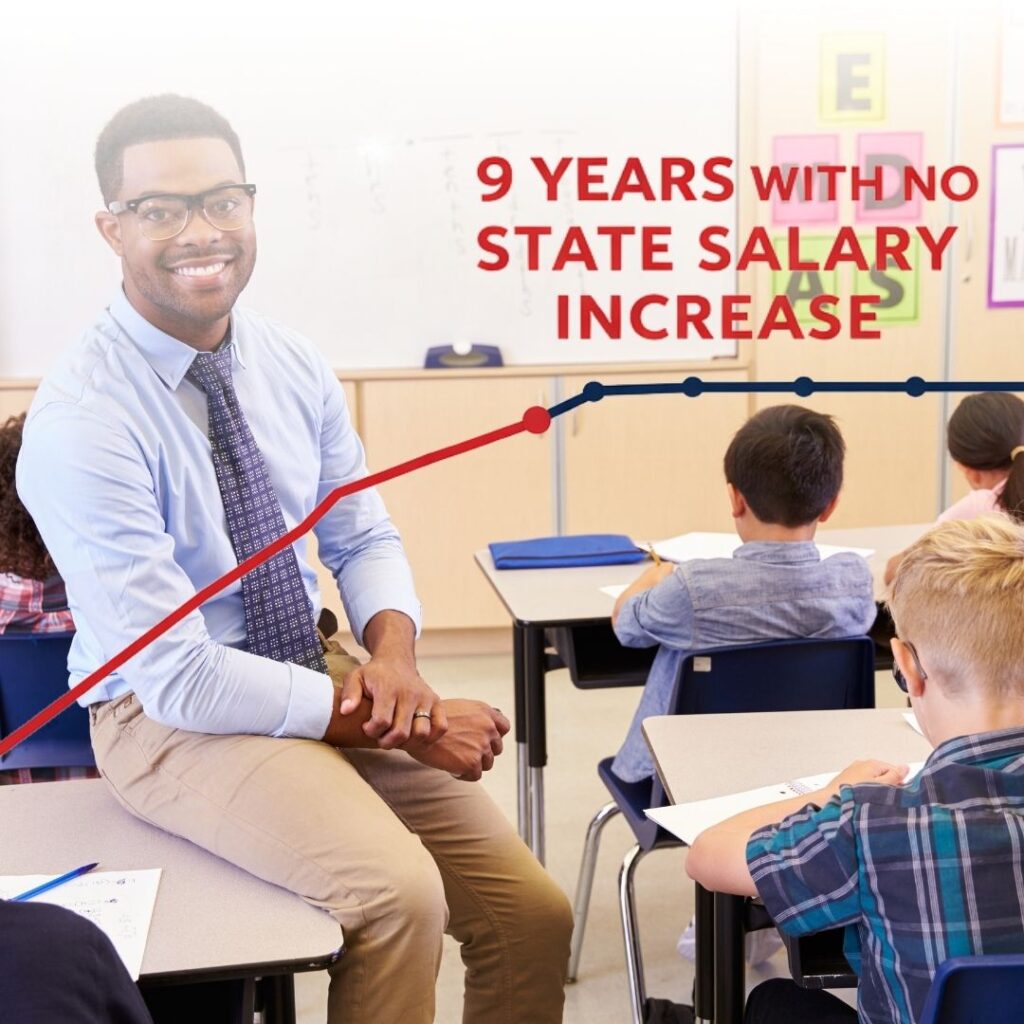
Most North Carolina teachers reach the maximum state salary after about 15 years in the classroom — a structure that increasingly leaves local communities like Wake County filling the gap.
North Carolina’s teacher pay system tells a story that should concern every community that depends on strong public schools — including Wake County.
For most teachers with a bachelor’s degree, the state salary schedule starts at $41,000. After 15 years in the classroom, their salary reaches $53,880. And then something unusual happens: the state salary schedule essentially stops.
From year 15 through year 25 and beyond, there are no additional state salary steps for most teachers.
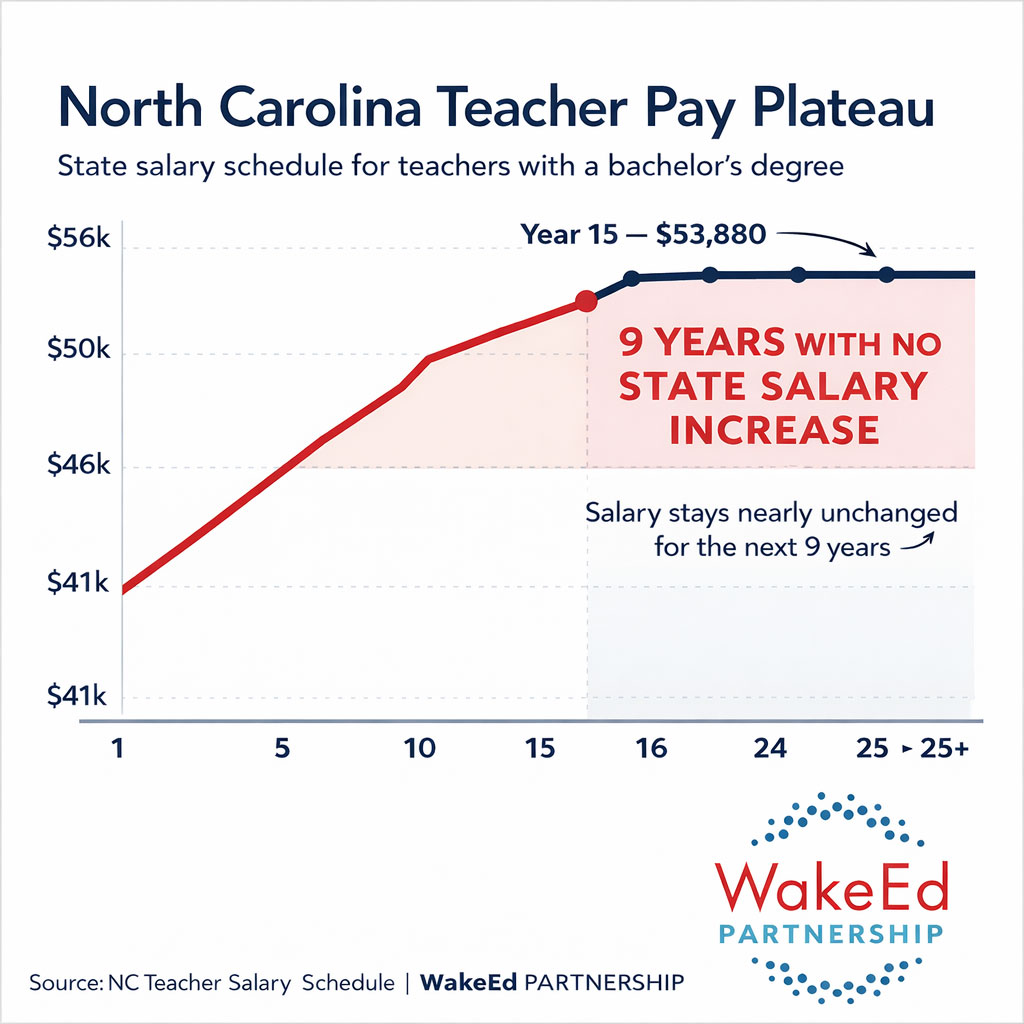
In practical terms, that means many educators reach their maximum state salary in their late 30s, even though they may continue teaching for another 25 or 30 years.
Few professions expect employees to spend the majority of their careers with little opportunity for salary growth.
What the Data Shows
This challenge is not just about one pay schedule. It reflects a broader pattern in how North Carolina funds public education.
According to national comparisons:
- North Carolina ranks 43rd in average teacher pay
- 50th in per-pupil funding
- 50th in overall funding effort
Meanwhile, neighboring states — including South Carolina — have increased investments in teacher compensation and now rank significantly higher.
These rankings make it harder for North Carolina school districts to compete for talent in a regional and national labor market.
Wake County’s Role
Here in Wake County, local leaders have worked hard to strengthen teacher compensation.
Through county funding, Wake County provides a local salary supplement currently averaging about $9,150 for teachers with a bachelor’s degree — an increase of roughly $2,950 over the past decade.
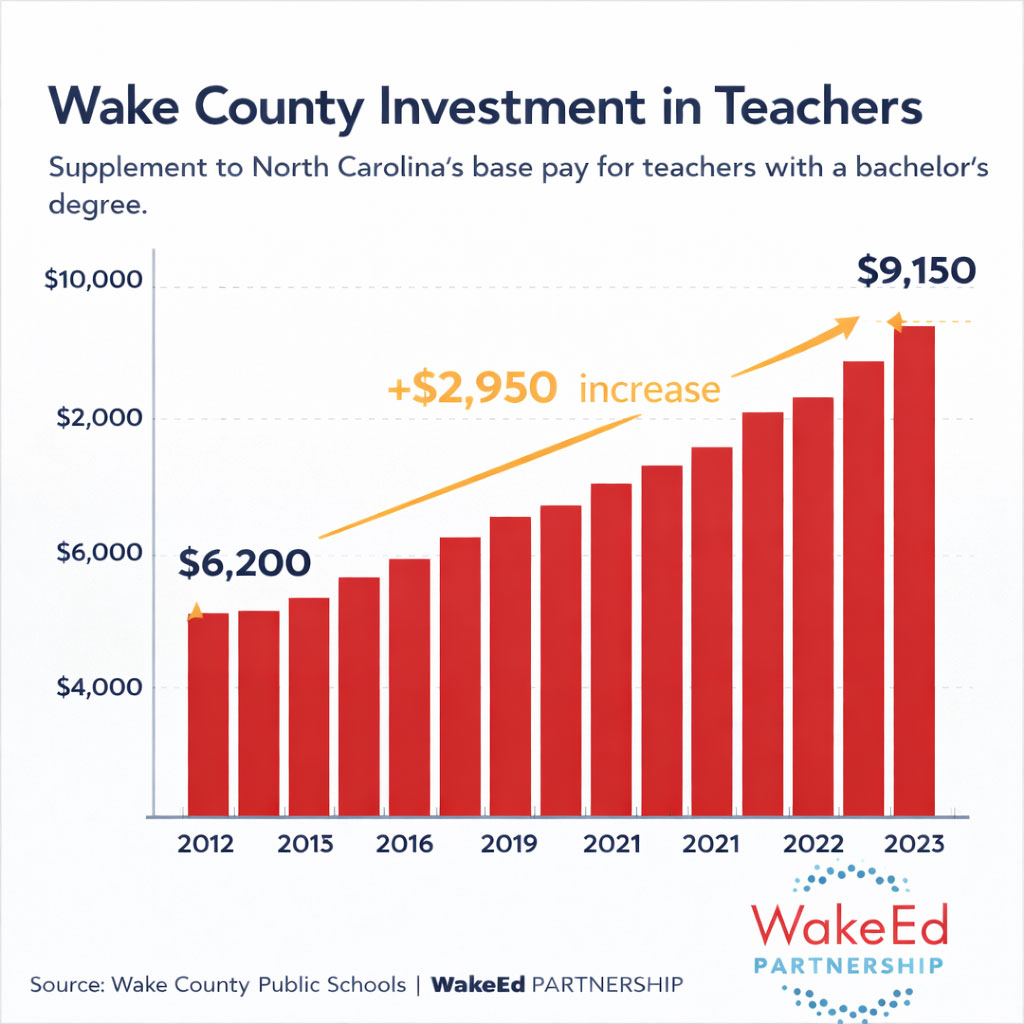
Those local investments matter. They help make Wake County more competitive in recruiting and retaining teachers.
But they also illustrate an important reality: local communities are increasingly being asked to fill gaps left by state funding.
Wake County’s strong economy, growing tax base, and longstanding commitment to public education have made these investments possible. Many communities across North Carolina do not have that same capacity.
Why This Matters
Competitive teacher pay is not simply about fairness for educators. It directly affects the ability of schools to attract and keep talented teachers in classrooms.
When compensation lags behind other professions — or behind neighboring states — school systems face greater challenges in recruitment and retention.
Wake County has taken meaningful steps locally to support teachers. But the scale of the challenge means local communities cannot solve the issue alone.
Under North Carolina’s constitution, the state bears the primary responsibility for providing every child access to a sound basic education — including ensuring schools can recruit and retain high-quality teachers.
Wake County’s investment in teacher pay reflects a community that values strong public schools. But the data in this issue makes clear that local leadership alone cannot solve a statewide challenge.
That responsibility ultimately rests with the General Assembly.