

Nearly two decades ago, WakeEd Partnership launched In Context to help our community better understand the policy and funding decisions shaping Wake County Public Schools.
From 2008 to 2020, this platform offered analysis and perspective on education budgets and legislation affecting students, educators, and our broader community. We are relaunching In Context at a critical moment.
North Carolina remains without a comprehensive state budget, and significant debate is underway around adequate school funding and teacher pay — including how our state compares to others in the region. These decisions carry real implications for students, educators, families, local taxpayers, and our regional economy.
In this edition, we examine what the budget impasse means, why it matters for Wake County, and what responsible leadership should look like moving forward.
Thank you for staying engaged.
Keith Poston
President, WakeEd Partnership
***
Every week, we see the consequences of state funding decisions up close.
At Tools4Schools — WakeEd Partnership’s free classroom supply store — teachers line up for basics: paper, notebooks, disinfecting wipes and pencils. Many spend more than $1,000 of their own money each year because state funding for instructional materials has declined while costs continue to rise.
Now consider this: months after the July 1, 2025 deadline, North Carolina still does not have a comprehensive new state budget. As of early 2026, we stand alone as the only state in the nation without one in place. Without a finalized plan, teacher raises are delayed, investments are stalled and school districts are left navigating prolonged uncertainty.
For educators, that uncertainty is personal.
The average teacher salary in North Carolina is about $58,000 — more than $12,000 below the national average. In the latest national report, North Carolina ranks 43rd in average teacher pay.
South Carolina ranks 23rd.
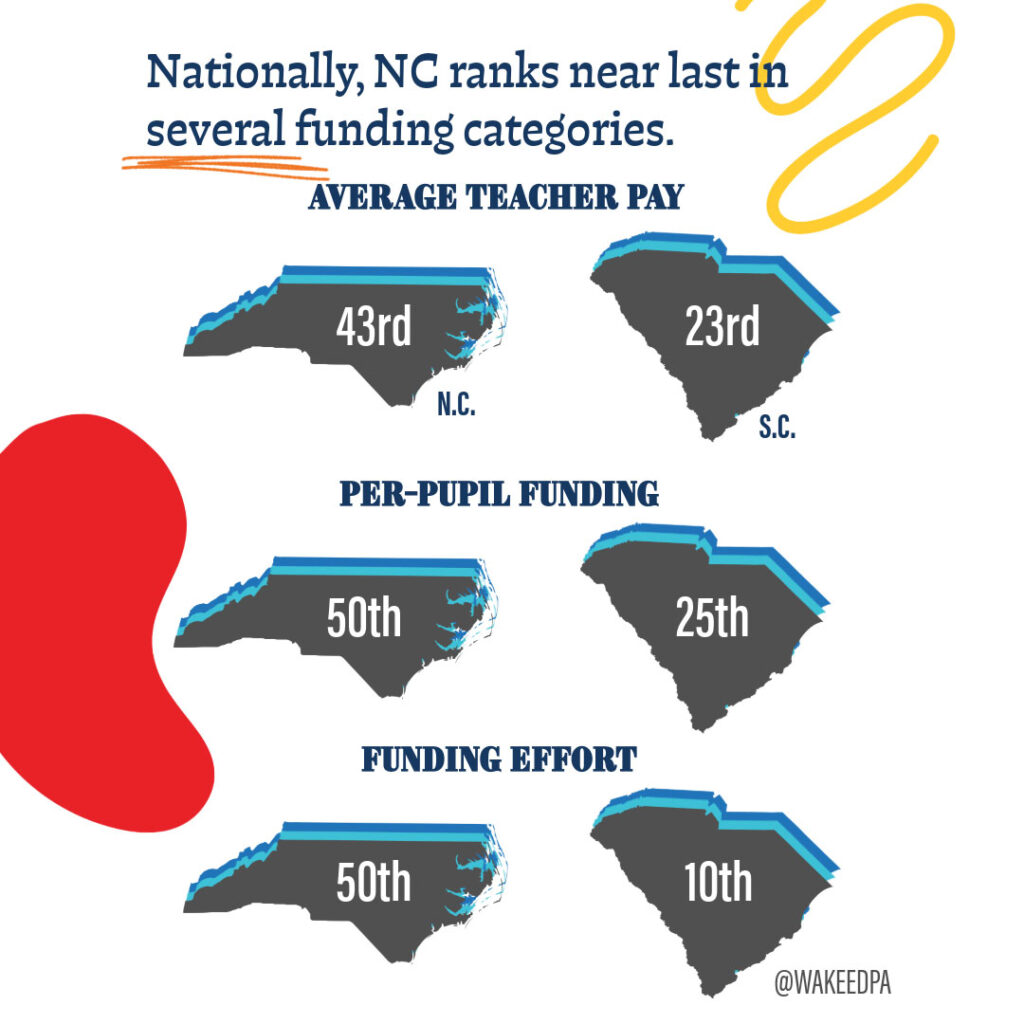
South Carolina now outpaces North Carolina in both average and starting salaries. For a state that once led the South in its commitment to public education, that should be a wake-up call.
This isn’t about pride. It’s about competitiveness.
Strong public schools are the heart of our community and the engine of our economy. When neighboring states invest more aggressively in teachers, they strengthen their workforce pipeline and signal long-term stability.
If South Carolina can prioritize educators, so can North Carolina.
Meanwhile, Wake County Public Schools — serving nearly 160,000 students — is navigating a significant budget shortfall and has asked for increased local funding, primarily from property taxes. When the state fails to provide adequate and timely investment, the burden shifts to local communities.
The cost does not disappear. It simply moves.
North Carolina should not be looking up at South Carolina when it comes to investing in education. We should be setting the pace.
It is time for legislative leaders to resolve their differences, pass a comprehensive budget, deliver meaningful teacher raises and invest at a level that reflects both our economic strength and our students’ needs.
Strong public schools do not happen by accident. They thrive when a state makes the deliberate choice to fund them accordingly.